
History of the Pet Industry
Prior to the 1950’s, holistic dog training was not the method of preference. Dogs were viewed from a utilitarian perspective – as a tool to make a job easier. Beginning in the 1950’s and 60’s, the pet dog industry really started to take off. We saw the creation of dry kibble in 1956. The first national pet store franchise appeared in 1965. In 1964, a marketing campaign launched. It portrayed kibble as the only option for our dogs. How many of you remember the Kanine Krunchies jingle from the 1961 101 Dalmatians cartoon?

In the years since, the pet industry has grown at an astronomical pace. In 2017-18, Americans spent over $72 billion dollars on our pets. This figure jumped to an unbelievable $103 billion in 2020! According to the 2021-2022 APPA National Pet Owners Survey, 69 million households in the U.S. have at least one dog. Over 90 million homes have at least one pet. When the survey was first conducted in 1988, 56% of U.S. households owned a pet. This percent has grown to 70% according to the latest survey.
History of Dog Training
Around this same time, dog training for the general public began to emerge as well. Since many of the early trainers were former WWII military dog handlers, training methods were based on that early training style. Techniques such as leash jerks, punishment and forced submission were common. In the 1960’s and 70’s, we saw the further development of dominance training. “How to be the alpha dog” by trainers like William Koehler and the Monks of Skete rose to fame. It was not until Dr. Ian Dunbar entered the scene in the 1980’s that we really start to see reward-based, positive reinforcement training methods begin to rise in popularity.
“When I’m training a dog, I develop a relationship with that dog. He’s my buddy, and I want to make training fun.”
~Dr. Ian Dunbar
In 1984, Karen Pryor’s book, Don’t Shoot the Dog, appeared on bookshelves. Karen Pryor, a marine biologist and marine mammal trainer, showed the world that marine animals could be trained using rewards. There is no reason that pet dogs should be trained using other methods.
In this video, world-renowned trainers talk about the misconceptions and myths surrounding the concept of dominance in dogs.

Current Dog Training Methods
In the past 20 years, the science around dogs and dog training has advanced in leaps and bounds. We now know those old myths about dog owners needing to be the “alpha”, “dominant” or the “pack leader” are just that … MYTHS. We know that our dogs learn best through reward-based training and that punishment often has long-term fallout. We know that our dogs’ personalities are unique. Many different factors influence personality. For example, what the dog has learned in their lifetime, what their ancestors learned in their lifetime, what is mapped out in their DNA, how they feel, their health, etc. We shape our relationship with our dogs through our interactions in daily life, during training, etc.
Philosophy of Holistic Dog Training
The idea that what creates the dog that is sitting in front of you is based solely on Nature OR Nurture could not be farther from the truth. It is, in fact, based on Nature AND Nurture. This is, in fact, the philosophy behind holistic dog training. “It is all in how you raise them” only looks at a single chapter in the book of DOG. Puppies raised perfectly can still grow up to be fearful or reactive dogs … AND puppies that had a horrible start in life can grow into extremely well-adjusted dogs.
A holistic dog trainer looks at the big picture of animal welfare. E.g., how has your dog’s nutritional, environmental, health and behavioral experiences affected his mental state to mold the individual sitting in front of us.
“Each individual is a study of one.”
~ Dr. Susan Friedman
Animal Welfare
Ruth Harrison’s 1964 book, “Animal Machines”, was an airhorn to the world about how animals were being treated. In response, the British government created the Farm Animal Welfare Advisory Committee. This committee, in turn, wrote the Brambell Report created the Five Freedoms of Animal Welfare.
- Freedom from hunger and thirst.
- Freedom from discomfort.
- Freedom from pain, injury or disease
- Freedom to express normal behavior
- Freedom from fear and Distress
These Five Freedoms have been used internationally as the basis for animal care and welfare since they were introduced. The Five Freedoms are essentially the amount of suffering that we allow an animal to feel before we are required to act.
In 1994, Mellor and Reid delved further into animal welfare and came up with the Five Domains Model. Their model is an aid to determine whether an animal had “A Life Worth Living”. The Five Domains Model takes the Five Freedoms and splits them into four domains that interact with and influence a new fifth domain – the animal’s mental state. The individual’s mental state is then used to determine their overall welfare.
The Five Domains
- Nutrition
- Water: availability, quantity, quality
- Food: availability, quantity, quality; balanced diet; age appropriate
- Supplements: vitamins, minerals, pre- & pro-biotics
- Living Environment
- Climate; Weather; Exposure; Light; Sound; Odors; Pollutants; Allergens; Confinement; Substrate; Predictable/Unpredictable Events; Patterns; Family; Stability; Socialization
- Health and Fitness
- Gender; Age; Reproductive Status; Injury, Disease; Physical/Functional Impairment; Body Condition; Physical Fitness; Vaccinations; Access to Vet Care;
- Behavioral Interactions
- Interactions with Environment, Other Animals and/or Humans; Agency (choice and control); Play; Sleep; Threats; Instincts; Breed Predispositions; Training; Learning
- Mental State
- Personality; Trauma; Stress; Feelings and Emotions e.g., pain/pleasure, hunger/thirst/satiated, cool/hot, itchy, stiffness, weak/strong, anger, boredom, loneliness, helplessness, anger, fulfilled, safety/security, etc.
No animal will ever be free of negative affects. When measuring welfare, we look at these categories and determine where there are negative and positive affects. Then we determine ways to make changes that will minimize negatives and increase the positives wherever possible. Thereby, bettering the animal’s welfare.
Holistic Training and Animal Welfare
As a dog behavior consultant, I look beyond “fixing” a specific issue. Instead, I take a holistic approach to assessing each dog based on their welfare needs. I will meet you and your dog where you are right now. We will work with ALL of the needs that both you and your dog bring to the table. My goal is to help you and your dog build a relationship based in trust and understanding. Rather than setting out to simply “fix bad behaviors” through obedience training, we will work together to create meaningful solutions.
We will talk about why your dog does what he does and how his needs may be affecting his behavior. Our conversation is based on honesty, compassion, understanding and compromise. We will create a plan that will set both you and your dog up for success. I will ask for compromise on your part in order to address your goals and meet your dog’s needs. This plan will include management protocols, enrichment activities and teaching new skills.
Health and Nutrition
A holistic trainer always looks at the dog sitting before them as a unique individual with unique needs. For example, the needs of a stray, skinny momma dog with 6 puppies are drastically different than the needs of the pampered, neutered Labrador who eats the most expensive dog food and has his own leather couch. We always need to start with the dog as the individual, not a a dog in general.
Before suggesting any kind of training, a holistic trainer will first want to address your dog’s health and nutrition. Is he in the middle of a growth spurt and is hungry all the time because he isn’t getting enough to eat? Is she feeling a bit sick to her stomach? Did your senior pup struggling with chronic pain related to osteoarthritis? These circumstances affect your dog’s response when a loose dog jumps in their face on a walk. This is why a holistic trainer might suggest a visit to your veterinarian before any discussion of training.
“Do the best you can until you know better. Then, when you know better, do better.”
~ Maya Angelou
~ Maya Angelou
Learning
How can we teach our dogs new skills to address behavior issues? The first thing that we need to understand is that your dog is learning every second of every day throughout his entire life. He is learning what is safe and what is not safe; what produces a reward and what produces a punishment; what works and what doesn’t work. His DNA is also chock full of information based on what his ancestors learned during their lifetimes! Your dog predicts, anticipates, and then adapts to, what will happen or what will or will not work in a new situation based on what he has learned AND on what has come hard-wired from ancestral learning.
Learning is never static
Learning is never static … rather, it is fluid. We have the opportunity to help shape that dog sitting in front of us. A fearful puppy can become more confident through positive socialization experiences. We can help a neglected or abused dog learn to trust us.
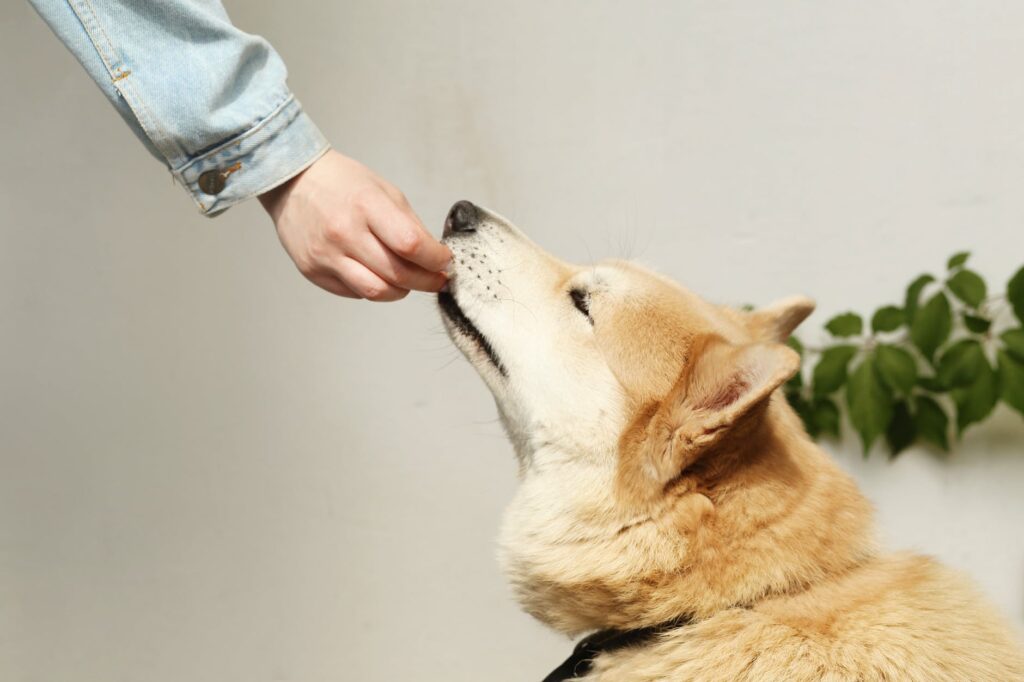
We can teach a dog who jumps all over everyone some alternative methods of greeting, simply by rewarding preferred behaviors. Remember, a dog learns what works and what doesn’t work through trial and error. If you teach your dog that keeping all four feet on the floor results in tons of yummy treats and attention. How do you think your dog’s default behavior will change in the future?
The first thing we look at is how can we change the environment to help set your dog up for success? Your dog’s environment isn’t just the inside of your house and the yard. It is everything that your dog encounters and interacts with every single day. A dog’s environment is continually creating questions and answers – Am I safe? What is happening? What do I do? I know what this means! Our job as the human in this relationship is to control the environment to keep our dog safe and to make sure that it provides the things that our dog needs.
Example 1: Is your puppy chewing on “inappropriate items?
When puppies are teething, they look for items to chew on that will help alleviate pain and discomfort. Ideal textures just happen to be the materials used to create furniture and shoes. Wood and leather are strong, with just enough give for your puppy to really sink his sore teeth into. A teething puppy is going to chew. Fact. A puppy does not have the ability to differentiate between a human toy and a dog toy. Fact. So, rather than getting mad at your puppy for chewing up your stuff, manage his environment. Don’t allow him to have access to these tempting items. Instead, provide him with a wealth of appropriate chew toys of different textures.
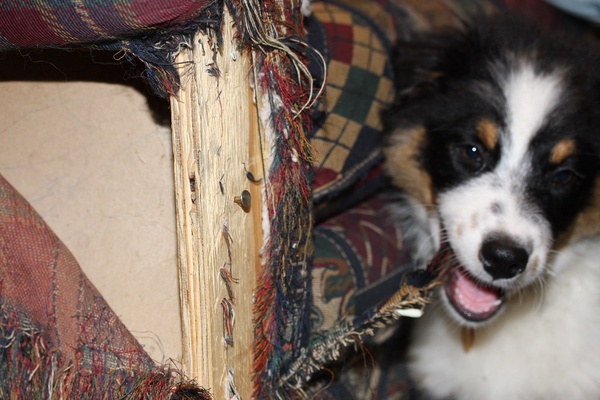
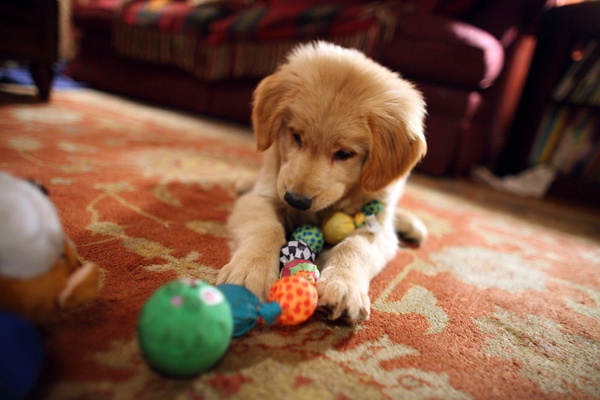
Generally, managing the environment is all that is needed to address puppy chewing since it is typically just a phase. But how would a holistic trainer approach a behavior that is not “just a phase”?
Example 2. Does your dog spend the day staring out the window and barking at every squirrel, person and leaf that appears?

First, we have to acknowledge that the barking is communication. He is just saying, “Hey, there’s a squirrel outside!” Every dog must be allowed to use his voice.
The first step is to help set him up for success by managing his environment. Close the curtains/blinds. Move that couch that he is using to see out the window. Cover the window with frosted window film. This prevents him practicing the old behavior. We can also provide him with opportunities to bark at and chase those squirrels in other situations.
This might be the entire solution for some dog guardians. However, others will want to work on teaching the dog to stop barking. Perhaps he can just bark a couple of times and then perform a more desireable behavior such as coming to look for you. While you are teaching him that alternative behavior, we will still use the management setup described in Step 1 to prevent the dog from practicing the undesired behavior while he is learning the desired behavior.
Genetics
How would a holistic trainer approach an issue that cannot be “fixed” with training? Genetics are hard-wired. They encompasses all of the information about life that is present in our dog’s DNA when she emerges from mom’s womb. These are the basics of what it is to be a dog (e.g., furry, four legs, barks, digs, chews, chases). Genetics also includes all of the specializations that humans have selected for and against for over 10,000 years ago. E.g., the basics of herding, guarding, companionship, retrieving, etc.
Genetic traits are things that we can enhance or moderate through training, but we cannot diminish them completely. In fact, to do so, would remove those characteristics that make your dog a dog (or a breed of dog). Barking, chewing, and digging are all part of the essence of what makes a dog a dog. To ask a terrier to stop digging or border collie to stop wanting to control a crowd is asking him to stop being a dog. What we can do, however, is to give that terrier a designated space where he can dig. We can teach that border collie herding games that do not involve young children and then put him in the house when we have a group of kids playing in the yard.
DNA and Breed Groups
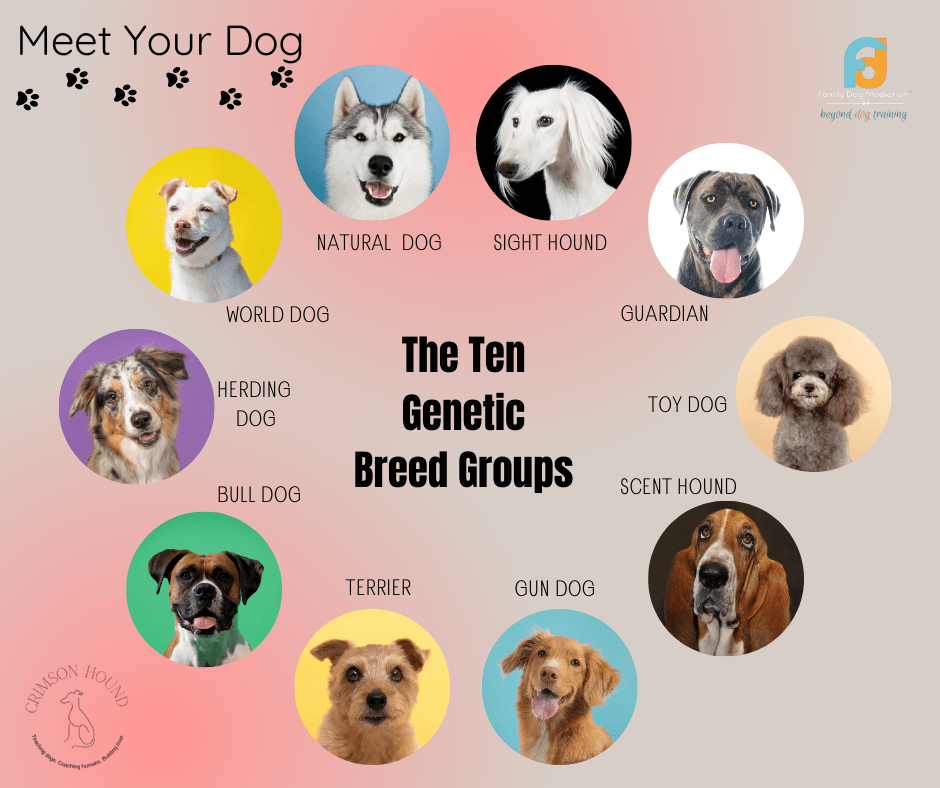
In her book, Meet Your Dog, Kim Brophey has sorted dog breeds into ten groups based on genetics. Knowing which breed group(s) your dog belongs to can give you general ideas about traits that you might expect to see.
Keep in mind that genetics is not predictive. Just because your dog has herding traits in his DNA, it doesn’t mean that he will be a herder. DNA can predict potential behaviors – it is not a guarantee. Rather than “My dog has Border Collie DNA, so he will be a great herding dog”, think in terms of “My dog has Border Collie DNA. That explains why he loves to herd the kids.”
Also keep in mind that many of these traits remain dormant until something turns them on. This could be the presence of a hormone, a certain stage of life, a scent or even an event. A dog can go through her entire life never having had the switch turned on.
Are they problem behaviors or unmet needs …
As the modern world continues to change, many of us find ourselves confused by the latest technology and even longing for days gone by. We don’t realize that these changes to our world have had drastic effects on our dogs’ lives as well. The majority of pet dogs, regardless of breed, live in an environment that is worlds away from the environment in which he was created to thrive. Those problem behaviors that we want a trainer to fix are just our dogs doing what we humans selectively, and very purposely, bred them to do for thousands of years. This is an issue that a holistic trainer will help you address. We will identify your dog’s needs and come up with ways to meet those needs
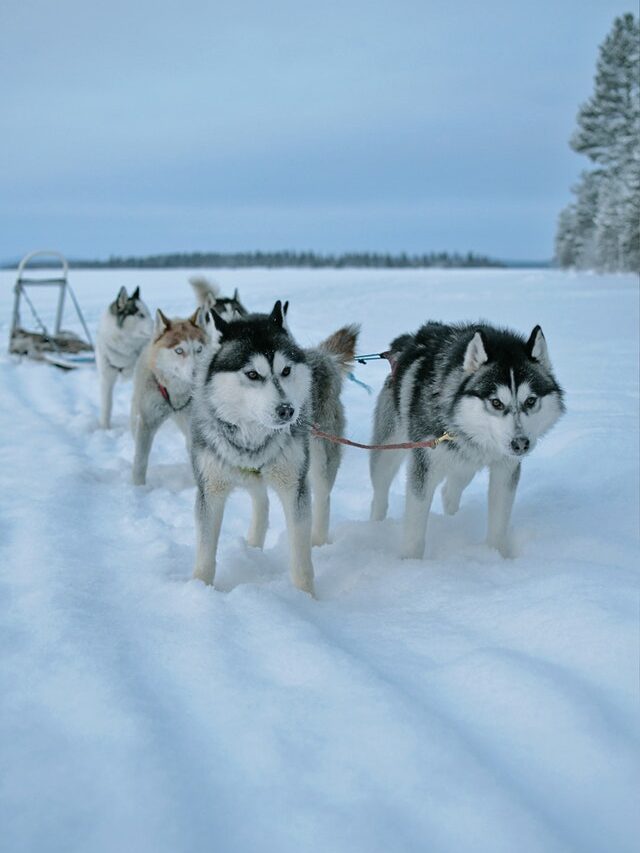
Huskies were selected to pull sleds across the arctic tundra. Today, we expect them to live happily in a condo in Florida.

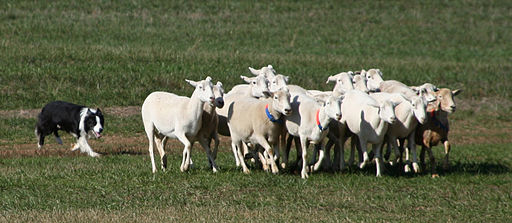
Border collies were bred to control chaos. He sees a sheep ¼ of a mile away take one step away from the flock and acts on impulse to bring him back to the flock. Today, we expect them to lie quietly while our young children run and scream through the house.
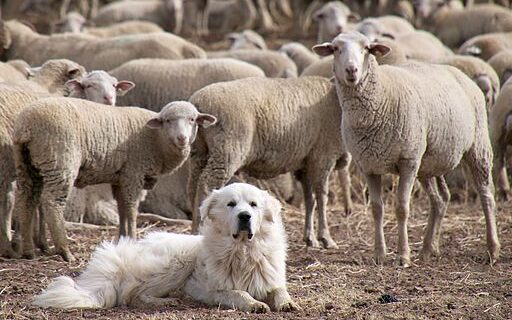
Great Pyrenees were created to live outside with the livestock. They were active at night and used their imposing presence and intimidating bark to scare away predators and thieves. Today, we expect them to lay quietly in the living room when visitors enter the home unannounced.
“If you think about it, it’s kind of a dirty trick to take a species that naturally chases moving objects, eats whatever it comes across, bites to argue, etc., and then announce all these as behavior problems.”
~ Jean Donaldson
… or perhaps it is just misplaced expectations?
Our pet dogs are captive animals with unmet instinctual needs and very little autonomy, as we control almost every aspect of their lives . . .when and where they eat, drink and sleep … when and where they go potty . . . who they interact with . . . how they play. You can count on one hand the aspects of our dogs’ lives that he controls.
Our dogs have been stripped of the right of refusal. Imagine, if you will, trying to dress up a wolf or a tiger – or even your cat. Get out the bandages, right?! But what happens when we decide to dress up our dogs? Now that’s a different story, our dogs had darn well better cooperate. In addition, think of this same wolf/tiger/cat/dog scenario in other circumstances – giving baths, grooming, walking on leash, recalls . . . even petting. In short, a dog is the only living being expected to perform perfectly regardless of what scenario is thrown at them. If they refuse, we seeit as a problem to be “fixed”.
Are these new scenarios realistic? Are they fair to the dog? And, in some cases, are they even humane? These are questions that you will talk about during your sessions with a holistic dog trainer.

Are these truly issues that need to be fixed . . . or do we just need to adjust our own expectations?
Mindset is key when working with our dogs. We need to take an honest look at our relationships with our dogs and ask ourselves . . .
– What was the original purpose of my dog?
– Am I offering my dog opportunities to meet his needs?
– Are my expectations realistic?
– How can I help my dog navigate this modern world?
Rather than choosing a dog on impulse, by color or because a friend just got that breed, take a long, honest look at your life style. Many breeds are simply not equipped to deal with the pet homes in which we are asking them to thrive.
When we are angry, embarrassed, or frustrated with our dog’s behavior, these feelings affect our relationship. They affect our ability to constructively help our dog modify those behaviors. Shifting our mindset from “My dog is giving me a hard time” to “My dog is having a hard time . . . having big feelings . . . feeling frustrated, confused or afraid” takes our relationship to a whole new level. It creates a stronger bond and provides a foundation for creating new behaviors.
Marissa Martino of Paws and Rewards Behavior Consulting has created a wonderful FREE mini-course called Powerful Perspectives. In this course, dog owners reflect on their feelings. Then they reframe their mindset from one of anger and frustration to one of empathy and understanding.
“Dogs are doing the best they can with the education we’ve given them in the environment we’ve put them in.”
~ Susan Garrett

Kerrie Hoar, M.S., CDBC, CCPDT-KA, ADT, FFCP
Kerrie has a master’s degree in Biology and is a certified professional dog trainer and family dog mediator. She own Crimson Hound LLC dog training in La Crosse, Wisconsin.